
People bring their whole lives to work.
A difficult situation at home can affect concentration. Financial pressure can affect sleep and energy. Grief, relationship challenges, caregiving responsibilities, or prolonged stress can eventually show up in attendance, performance, relationships, or simply in how someone experiences their work.
Organizations cannot solve every personal challenge their employees face. They can, however, make sure employees know where to turn when they need support.
That is one of the purposes of an Employee Assistance Program, or EAP.
What is an Employee Assistance Program?
An Employee Assistance Program is a voluntary and confidential workplace support program designed to help employees address personal or work-related challenges that may affect their wellbeing or their ability to function effectively at work.
EAPs commonly provide assessment, short-term counseling, referrals, and follow-up support. Depending on the program, services may also extend to eligible family or household members.
The important distinction is that an EAP is more than a counseling service.
It is a structured support resource that gives employees access to professional help when something is getting in the way of their wellbeing, their ability to cope, or their ability to function effectively.
For an organization, that makes an EAP part of a broader people strategy rather than simply another employee benefit.
What do EAPs typically cover?
The exact services vary by provider and by organization, but EAPs commonly support employees with a range of personal and workplace concerns.
Mental and emotional wellbeing
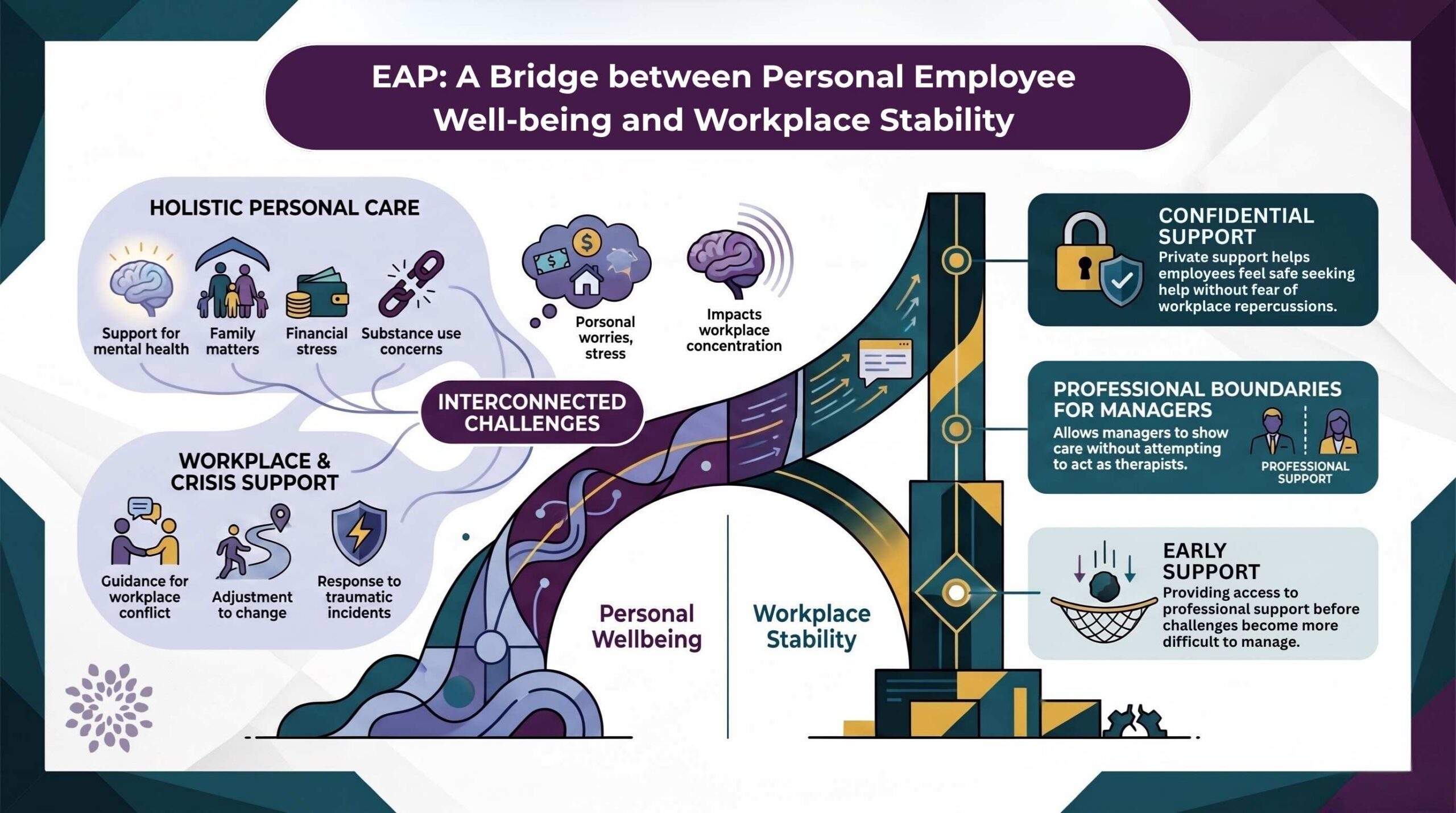
Short-term counseling and support for concerns such as stress, anxiety, grief, relationship difficulties, burnout, and other personal or emotional challenges.
Work-related concerns
Support with workplace stress, conflict, communication challenges, adjustment to change, and other situations that may affect an employee’s ability to cope at work.
Family and relationship matters
Guidance and referrals related to family difficulties, parenting, caregiving responsibilities, and other situations affecting life outside of work.
Financial wellbeing
Some programs provide financial guidance or referrals for concerns such as budgeting, debt, or financial stress.
Substance use and addiction
Assessment, counseling, and referrals for employees or eligible family members dealing with substance use or addiction-related concerns.
Critical incidents
EAP providers may also assist organizations and employees following difficult or traumatic workplace events. This can include crisis response, counseling, or other forms of support.
Many programs also offer educational resources, workshops, and consultation for managers and supervisors.
The range of services matters because employees do not always experience challenges in isolation.
A financial concern can create stress. A family situation can affect concentration at work. Workplace conflict can affect wellbeing outside of work.
An EAP can provide a starting point for addressing these challenges before they become more difficult to manage.
What does an EAP mean for employees?
For employees, one of the most valuable aspects of an EAP is access.
When support is available through the workplace, an employee does not necessarily have to figure out on their own where to go, who to contact, or how to begin.
EAPs are generally designed around confidentiality. The individual details of an employee’s use of the service should remain with the EAP provider, subject to the applicable confidentiality rules and limited exceptions. Organizations may receive general information about program utilization, but this is different from receiving an employee’s personal counseling information.
That distinction matters.
Employees need to feel that asking for help will not automatically become a workplace issue.
An EAP can also create an opportunity for earlier intervention. Employees do not necessarily have to wait until a situation becomes a crisis before looking for support.
Sometimes the right conversation, a practical referral, or a few short-term sessions can help someone regain perspective and determine what they need to do next.
For the employee, the value is not simply the service itself.
It is having a resource available when life becomes difficult.
What does an EAP mean for the organization?
This is where an EAP becomes more than an employee benefit.
When personal challenges remain unresolved, they can sometimes affect the workplace through absence, reduced concentration, lower work capacity, interpersonal difficulties, or declining performance.
Providing access to appropriate support can help address some of these challenges earlier.
Research on workplace interventions has found evidence of an effect on absenteeism, although the evidence is less conclusive when it comes to broad claims about productivity and work ability.
That is why organizations should be careful about viewing an EAP as a guaranteed productivity or ROI solution.
The stronger organizational argument is this:
An organization that makes it easier for employees to get appropriate support is better positioned to help people remain capable, engaged, and able to contribute.
An EAP can also give managers an important boundary.
Managers are often the first to notice that something is not right. But managers are not therapists, counselors, or social workers.
Their responsibility is to lead, manage performance, address workplace issues, and support their employees within their role.
An EAP gives them somewhere to direct employees when the situation requires support beyond what a manager should provide.
That can help prevent managers from trying to solve personal problems themselves while still allowing them to show care and support.
An EAP does not replace good management
This is an important distinction.
An EAP cannot compensate for poor leadership, excessive workloads, unresolved workplace conflict, inadequate staffing, or a culture that consistently creates unnecessary stress.
If an organization keeps referring employees to an EAP while ignoring the conditions contributing to their difficulties, it is addressing the symptom rather than the system.
This is why an EAP should sit alongside, not instead of, good organizational practices.
Clear expectations. Capable managers. Healthy workplace relationships. Meaningful development. Fair performance practices. Appropriate workloads.
These are organizational responsibilities.
An EAP provides another layer of support when employees encounter challenges that require additional help.
Making an EAP useful
Having an EAP in place is only the starting point. For it to become a meaningful resource, employees need to understand what it offers, how to access it, and how confidentiality is handled. SHRM identifies lack of awareness and concerns about confidentiality among the factors that can contribute to low EAP utilization.
Organizations therefore have a role to play in making the program visible and accessible. EAP information should be communicated clearly and regularly, rather than only when an employee is facing a crisis. Employees should understand that the program can be a resource for everyday challenges as well as more difficult situations.
For organizations in Aruba and across the Caribbean, EAP services are already available locally. Providers offer services such as assessment, short-term counseling, critical incident support, workplace training, and referrals.
An EAP works best when it is part of a broader approach to employee wellbeing and organizational effectiveness. It provides an additional layer of support for employees and managers, while the organization continues to address the workplace conditions, leadership practices, and systems that shape the employee experience.
Ultimately, the value of an EAP is not simply in having the program available. It is in creating a workplace where employees know where to turn when they need support, managers understand their role, and the organization takes responsibility for the environment in which people work.
Where Employee Support Becomes Organizational Strength
Supporting employees requires more than offering individual resources. It involves creating the right structures, leadership practices, and support systems to help people navigate challenges while strengthening organizational effectiveness.
At U-SparkPeople Management & Development Consultancy, we partner with organizations to strengthen their people practices.
If your organization is exploring how to establish an EAP or to strengthen the current support systems available to your employees, we’d welcome the opportunity to connect and discuss how we can help.