With layoffs occurring across the U.S. and around the world, it’s easy to assume that AI is replacing human work. Whether that belief is fully accurate isn’t the question we’re exploring here.
What is clear is that as this technology continues to improve, it can support and speed up certain tasks. In doing so, it allows roles to shift and gives people more time to focus on work that benefits most from human insight, judgment, and connection.
Customer service is a good example. Today, when you contact a company, your first interaction is often with an automated system that can handle routine questions. Writing an email? There’s software that can help with that, too. But when an issue is complex, or simply can’t be resolved through automation, it still needs to be routed to a person who can assess the situation, understand the context, and respond with care.
As these tools become more common, organizations still have to balance technology with the people behind the work. Human experience, perspective, and oversight remain necessary if systems are going to function well over time.
This shift brings renewed attention to the areas that AI can’t replace—those rooted in human interaction and human qualities. Technology can’t take the place of working through challenges with colleagues, building trust with clients or customers, or supporting students or patients through uncertainty. Even when work happens online, these interactions rely on presence, awareness, and responsiveness.
AI can help streamline processes, but it won’t make someone a stronger teammate, employee, or leader simply by being introduced into the workflow.
That’s why continued development of soft skills matters. These skills are often what help people stand out, particularly when others have focused only, or too heavily, on technical expertise.
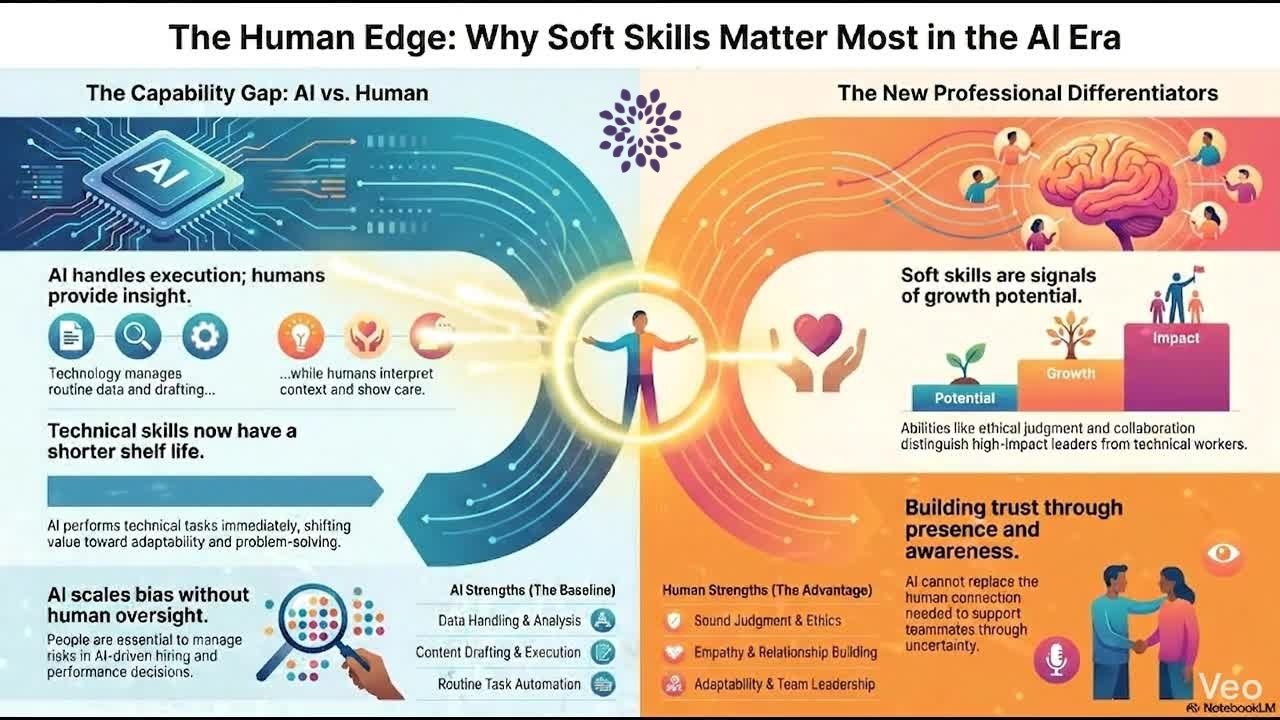
While AI models are increasingly strong at execution, data handling, analysis, and drafting content, they still fall short when it comes to sound judgment, earning trust, acting responsibly, or working effectively with people. Those abilities are shaped through experience and practice, not automation.
Part of the answer lies in how quickly AI is changing the value of technical skills. Many hard skills now have a shorter shelf life because technology can perform, or support, them almost immediately. As a result, the emphasis is shifting away from fixed expertise and toward adaptability: how people approach problems, learn, and work with others, not just which tools they know today.
This becomes especially clear in leadership roles. As teams become more hybrid and more reliant on AI‑supported tools, managers are expected to guide people through uncertainty, respond to concerns about automation, and interpret AI‑generated outputs within real‑world contexts. These responsibilities depend far more on communication, empathy, and ethical judgment than on technical knowledge alone.
At the same time, AI raises the cost of poor judgment. Technology doesn’t remove bias or risk, it can scale it. As organizations use AI in areas like hiring, performance evaluation, and pay decisions, human oversight becomes even more important. What matters isn’t only which tools are used, but how decisions are made and who takes responsibility for them.
All of this points to a broader shift in how skills are valued.
Hard skills still matter, but on their own they are no longer enough. In many cases, they have become baseline expectations, necessary to qualify for a role, but not enough to distinguish someone once they’re in it. Soft skills, by contrast, are stronger signals of impact, growth potential, and readiness for leadership. Abilities such as clear thinking, adaptability, communication, emotional awareness, ethical decision‑making, and collaboration help individuals and teams work well alongside AI.
These skills are increasingly important, but building them across an organization takes intention, not just awareness.
As AI continues to change how work gets done, it also creates space to rethink where people add the most value. When routine tasks are supported by technology, qualities like judgment, curiosity, cooperation, and care have more room to show up.
In that sense, this moment isn’t only about adjusting to new tools. It’s also about shaping work environments where human strengths are easier to use, easier to recognize, and more meaningful in the long run.
At U-SparkPeople Management & Development Consultancy, we support you in developing leaders at all levels of your organization. Our work focuses on how managers and leaders show up day to day, make decisions, and support people through change.
We offer coaching, guidance, and practical tools to help you:
Whether you’re reviewing how AI fits into your workplace or looking to strengthen the skills that help people work well alongside it, we’re here to support thoughtful, people‑centered approaches. If you’d like to start a conversation, we’d be glad to connect.