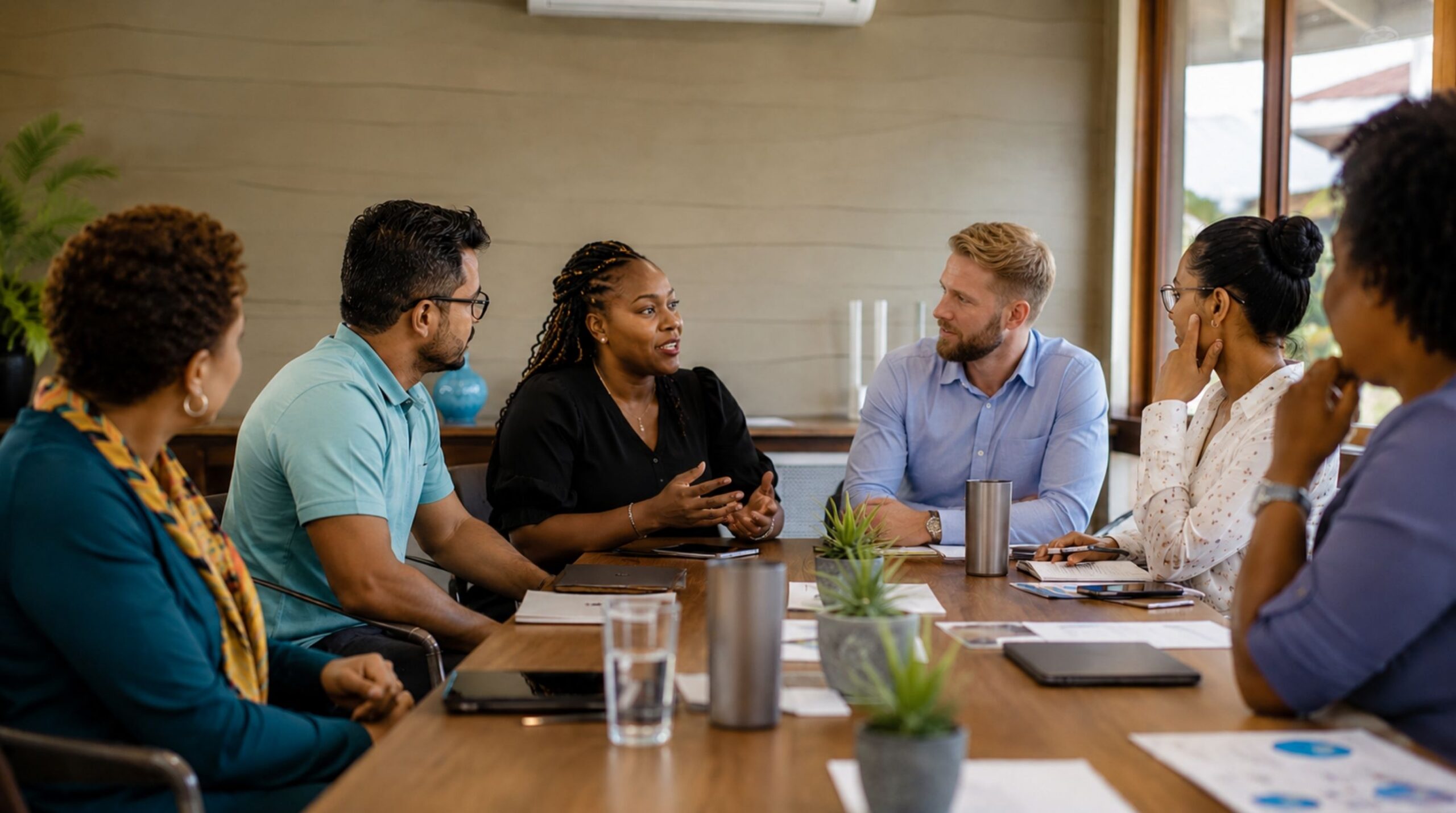
Walk into almost any Caribbean workplace and diversity is immediately visible. Employees may come from different islands, countries, cultures, generations, religions, and educational backgrounds. Several languages may be spoken during the same working day. Some employees were born locally; others migrated in search of employment, stability, or greater opportunity.
This diversity is not accidental. It reflects the Caribbean’s history, migration patterns, cultural influences, and economic realities. Small labor markets, skills shortages, and industries such as tourism, hospitality, construction, healthcare, and financial services have made diverse workforces an operational necessity.
But diversity and inclusion are not the same.
Diversity tells us who is present. Inclusion tells us who is heard, trusted, developed, and given a fair opportunity to progress.
In the diversity-awareness conversations we have facilitated, leaders often begin by describing diversity in terms of the nationalities or cultures represented in their organizations. The conversation changes when we begin asking different questions. Who participates in important decisions? Who receives development opportunities? Whose ideas are taken seriously? Who adjusts to the dominant workplace culture, and who is expected to do the adjusting?
These questions reveal whether diversity is simply visible or whether it is contributing to the strength of the business.
Diversity Is Already Part of the Caribbean Business Model
Migration has long shaped Caribbean societies and labor markets. A 2023 review by the Inter-American Development Bank and the Migration Policy Institute estimated that 859,400 intraregional and 745,700 extra-regional immigrants were living in Caribbean countries in 2020. The share of immigrants coming from within the region increased from 46% in 2000 to 56% in 2020.
For Caribbean employers, this means that differences in language, nationality, culture, and ways of working are not occasional issues. They are part of the everyday reality of doing business.
Migrant employees help fill critical vacancies, transfer knowledge, and support industries that may otherwise struggle to find sufficient labor. Yet employment does not automatically lead to integration.
An employee may be part of the workforce but remain excluded from informal networks, important conversations, or development opportunities. Language may affect how confidently someone contributes in a meeting. Cultural differences in communication may be misread as a lack of initiative, confidence, or leadership potential. An employee whose immigration status is linked to the employer may also feel less able to question unfair treatment.
The business challenge is therefore not simply how to recruit a diverse workforce. It is how to manage that workforce fairly and effectively.
Representation Alone Does Not Create Business Value
Organizations often measure diversity by counting how many different groups are represented. Representation matters, but it does not show whether people are able to influence the work.
A 2023 study of 1,979 firms across 13 Caribbean countries found that gender diversity improved the likelihood of innovation and increased the likelihood that firms would collaborate with external partners to innovate. The study also found that the impact depended on where women were represented. Gender diversity across the total workforce was more effective than diversity limited mainly to management positions.
This is an important distinction.
The business value of diversity does not come from placing one or two people from underrepresented groups in visible roles. It comes from involving different people throughout the organization, in operations, problem-solving, customer decisions, product development, and improvement initiatives.
Inclusion determines whether different perspectives are actively used or quietly overlooked.
The same principle applies beyond gender. Recruiting people of different nationalities does not help the organization if language prevents some employees from participating. Employing a person with a disability does not create inclusion if the workplace, technology, or communication process remains inaccessible. Hiring younger employees does not strengthen the talent pipeline if they are given tasks but no coaching, exposure, or opportunity to develop.
The Gap Between Intention and Experience
Most Caribbean organizations would describe themselves as welcoming and respectful. The more difficult question is whether employees experience the workplace that way.
A 2024 University of Aruba study explored employees’ perceptions of diversity management in the tourism industry. The qualitative study was based on 14 semi-structured interviews, so it should not be treated as representative of the entire industry. However, its findings point to a useful tension.
Participants generally viewed diversity as important and believed that it was reflected in recruitment, selection, and talent development. At the same time, they could not identify diversity-specific policies in their organizations and reported that diversity training was not provided. Some participants also identified communication as a challenge in a diverse work environment.
This illustrates a situation that may be familiar to many Caribbean businesses: diversity exists, and leaders may have positive intentions, but the approach to inclusion remains largely informal.
When inclusion depends on individual goodwill, the employee experience can vary significantly between departments and managers. One manager may actively invite different perspectives, while another repeatedly turns to the same trusted employees. One department may communicate important information in a way everyone understands, while another assumes that all employees can follow the language and style preferred by the dominant group. (Read more on Preventing Workplace Harassment)
Good intentions matter, but they do not replace a structured approach to management.
Inclusion Lives in Everyday Business Decisions
Inclusion becomes real through the way people enter the organization, participate in the work, and progress within it.
It begins with recruitment. Employers should consider whether vacancies are reaching a broad talent pool or circulating mainly through familiar networks. Selection criteria should be clear enough to prevent “cultural fit” from becoming a preference for people who look, speak, or think like those already in the organization. Recruitment systems and interviews should also be accessible to candidates with different needs.
Inclusion continues in meetings and daily communication. Leaders should notice who speaks, who remains quiet, who is interrupted, and whose ideas are acted upon. In multilingual workplaces, they must also consider whether the language being used allows everyone to understand important instructions, contribute to discussions, and perform safely.
It becomes particularly visible in development and advancement. Who receives mentoring, training, high-profile assignments, and exposure to senior leaders? Are these opportunities openly communicated or offered informally to employees who are already connected and visible?
These decisions may appear small when considered individually. Together, they shape who grows within the organization and who remains on the margins.
Awareness Must Lead to Better Management
Diversity awareness is an important starting point because people do not always recognize how assumptions influence their behavior.
Exclusion is rarely introduced through an official decision to keep someone out. More often, it develops through habits: recruiting from the same networks, speaking in the language most comfortable for the majority, selecting the person who feels most familiar, or repeatedly offering opportunities to employees who are already visible.
Awareness helps people notice these patterns. Leadership must then translate that awareness into practical changes.
This does not require every organization to introduce a complicated diversity program. It requires leaders to examine whether their current practices allow different people to perform, contribute, and advance.
It also requires honest employee input. Workforce statistics can show who has been hired, but they cannot fully explain how people experience the organization. Leaders need to understand why some employees stop contributing in meetings, why certain groups remain concentrated in particular roles, and why capable people leave despite appearing engaged.
The purpose is not to treat every difference as a problem. It is to identify whether the organization is unintentionally limiting the talent it already has.
From Workforce Diversity to Organizational Strength
The Caribbean workplace is diverse. That is one of the region’s greatest assets.
But diversity created by history, migration, culture, gender participation, and economic necessity does not automatically become inclusion. That requires deliberate leadership, fair access to opportunity, employee voice, accessibility, and workplace practices that allow different people to contribute and progress.
For Caribbean businesses, inclusion is not separate from performance. It affects how effectively teams communicate, whether risks and ideas are raised, how well talent is developed, and whether the organization can benefit from the perspectives already present within its workforce.
The question is no longer whether our workplaces are diverse.
The question is whether we are managing that diversity well enough for both our people and our businesses to benefit from it.

About The Author
Charlène Nectar is the Founder and Managing Director of U‑SparkPeople Management & Development Consultancy. She specializes in strategic HR and leadership, supporting organizations in Aruba and the Dutch Caribbean.
A certified Strategic HR Leader and Gallup Strengths Coach, she is also President of the Aruba Human Resources Association.
Where Individual Growth Meets Organizational Performance
Sustainable performance depends on both individual capability and a safe, respectful work environment.
At U-SparkPeople Management & Development Consultancy, we support organizations in strengthening leadership and supporting safe, respectful workplace practices. We also support individuals in navigating their growth with clarity.
If this perspective resonates with your current challenges or priorities, we invite you to connect.